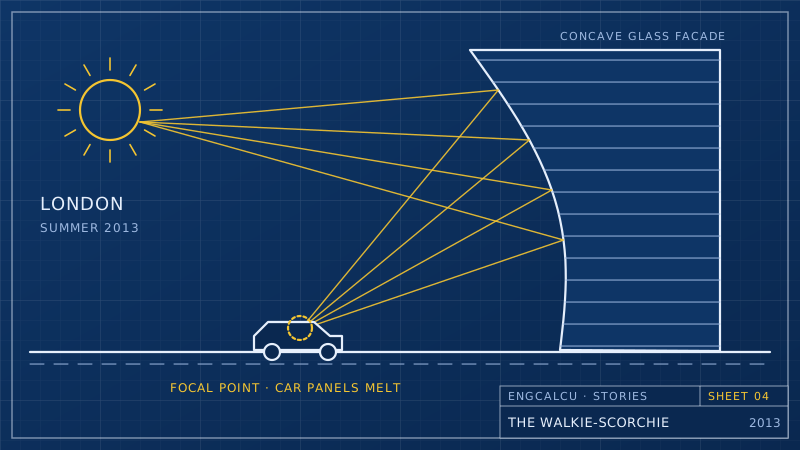
In the summer of 2013, a businessman parked his Jaguar on Eastcheap in the City of London. When he came back, parts of it had melted: the wing mirror, a badge and some of the body panels had warped and buckled. The culprit was a skyscraper across the road.
A building shaped like a lens
The tower at 20 Fenchurch Street, nicknamed the Walkie-Talkie for its shape, gets wider as it rises so that the upper floors, which rent for more money, have more space. Its south face curves outwards in a concave shape, covered in glass.
A concave mirror has a well-known property: it collects light and focuses it onto a small area. For a few weeks around midsummer, when the sun was at the right angle, the glass facade acted like a giant magnifying glass and focused a hot beam of sunlight onto the street below.
Frying eggs on the pavement
Journalists rushed to measure it. Temperatures at the focal spot were reported at well over 100 °C, and one reporter famously fried an egg in a pan on the pavement. Shops nearby reported scorched doormats and cracked tiles. The newspapers renamed the tower the Walkie-Scorchie.
The developers paid for the damage to the car and put up temporary screens at street level. In 2014 a permanent fix was installed: horizontal sunshade fins, known as brise soleil, fixed across the south face to break up the reflected light.
It had happened before
The same architect had seen a similar problem in 2010 at the Vdara hotel in Las Vegas, where the curved glass tower focused sunlight onto the pool deck. Guests complained of burnt skin and melted plastic bags, and staff called the hot spot the "death ray". The lesson had been available. It was not fully applied.
Facade design is not only about looks and thermal performance. Curved, reflective surfaces need a solar glare and reflection study, which is now standard in many cities. In sunny climates like the UAE, where glass towers are common, reflected heat and glare studies matter even more.