The tallest building in the world was built in one of the hottest places on Earth. That created a simple but serious problem: how do you place high-strength concrete in 45 °C summer heat, and then push it more than half a kilometre into the sky?
Concrete hates heat
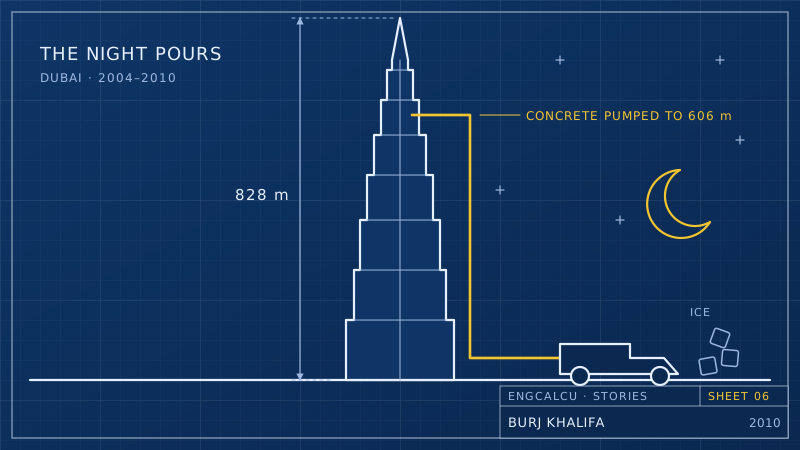
When cement mixes with water, it gives off heat. In hot weather that reaction speeds up, the concrete stiffens before it can be placed properly, and large pours can crack as they cool. For the Burj Khalifa, which opened on 4 January 2010 at 828 metres tall, the structural core and walls had to be very high-strength concrete, cast quickly, floor after floor.
The answer: ice and moonlight
The contractors fought the heat in two ways. First, the concrete was chilled at the batching plant, and part of the mixing water was replaced with ice. Second, the major pours took place at night, when air temperatures were lower and the concrete could be placed before it began to stiffen. Night shifts in the summer became the normal rhythm of the job.
A world pumping record
Most tall buildings lift concrete in buckets by crane. At the Burj Khalifa, high-pressure stationary pumps pushed it up steel pipelines inside the building. In 2008 the team set a world record, pumping concrete to a height of 606 metres. The mix had to be designed so it stayed fluid and did not separate under huge pressure on the way up, then gained strength quickly once it arrived.
Designed to confuse the wind
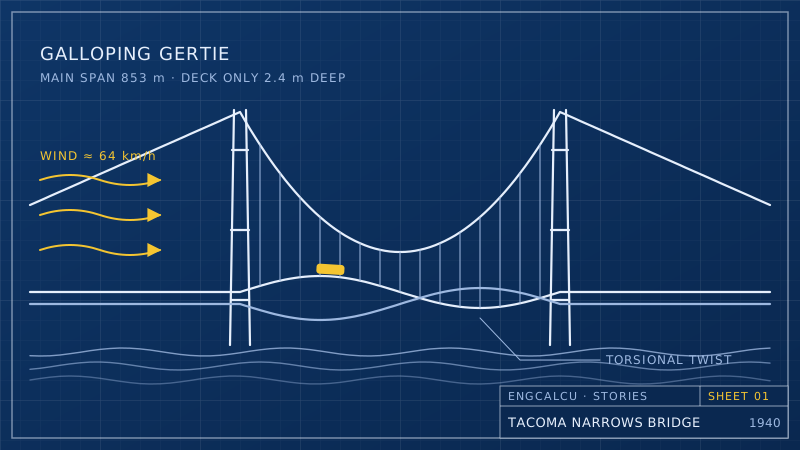
The tower's Y-shaped plan, inspired by a desert flower, gives the central core three wings that brace each other, a system called a buttressed core. As the tower rises, the wings step back in a spiral pattern. Each change in shape breaks up the wind vortices that try to form around the building, so they never organise into a steady rhythm. The lesson of Tacoma Narrows, 70 years later, shaped the world's tallest tower.
The whole structure stands on a thick reinforced concrete raft supported by hundreds of deep bored piles, which carry its weight down into the ground beneath Downtown Dubai.
Hot-weather concreting is a planning problem as much as a materials problem. Limiting concrete temperature, scheduling pours for cooler hours and planning the pumping route are all decided long before the first truck arrives. The same rules apply on every slab pour in the UAE.