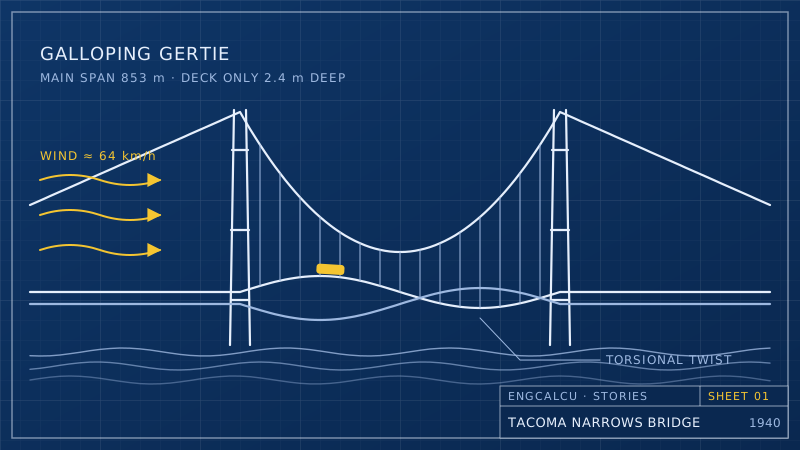
On the morning of 7 November 1940, a steady wind of about 64 km/h blew down Puget Sound in Washington State. It was not a storm. Yet within a few hours, the third-longest suspension bridge in the world was twisting like a ribbon, and by 11:00 its main span had dropped into the water below.
A bridge that bounced from day one
The Tacoma Narrows Bridge opened on 1 July 1940 with a main span of 853 metres. To save money, the design replaced a deep stiffening truss with a plate girder deck only 2.4 metres deep. On paper it was elegant and light. In practice it moved.
Even during construction, workers noticed the deck rising and falling in gentle winds. Some chewed lemons to fight seasickness. Once it opened, drivers came from far away to ride the waves, and locals gave it a nickname that stuck: Galloping Gertie. The bridge authority fitted tie-down cables and dampers, but the motion continued.
The morning it twisted
On 7 November the movement changed. Instead of bouncing up and down, the deck began to twist about its centre line, one edge rising while the other fell. A cable band at mid-span had slipped, and the torsional motion grew until the roadway was tilting by around 28 degrees each way.
A newspaper editor, Leonard Coatsworth, was driving across when the twisting began. He abandoned his car and crawled to safety on his hands and knees, but his daughter's cocker spaniel, Tubby, was still inside. Tubby was the only life lost that day. The car is still on the bottom of the Sound.
Local camera shop owners filmed the whole collapse. That footage is now shown in almost every engineering school in the world.
Not just "resonance"
The collapse is often explained as simple resonance, like a singer shattering a glass. Engineers now describe it as aeroelastic flutter. As the slender deck twisted, it changed how the wind flowed around it, and the wind then pushed it further in the same direction. The structure was feeding energy into its own motion. A deep, open truss lets wind pass through; a shallow solid girder catches it like a wing.
What came next
The replacement bridge opened in 1950 with a deep stiffening truss and openings in the deck to let wind pass through. More importantly, Tacoma made wind tunnel testing standard for long-span bridges. Today, every major suspension and cable-stayed bridge is tested on scale models before construction begins.
Saving material is good engineering only until it changes how the structure behaves. Check stiffness and dynamic response, not just strength. A design can pass every static load check and still fail in a moderate wind.