On 11 November 2026, the fastest ocean liner ever built began its last voyage: straight down. The SS United States, which has held the record for crossing the Atlantic since 1952, was flooded on purpose in the Gulf of Mexico to become the world's largest artificial reef. Her design was remarkable from the start, and so was the way she was sent to the seabed.
A ship designed around fire and speed
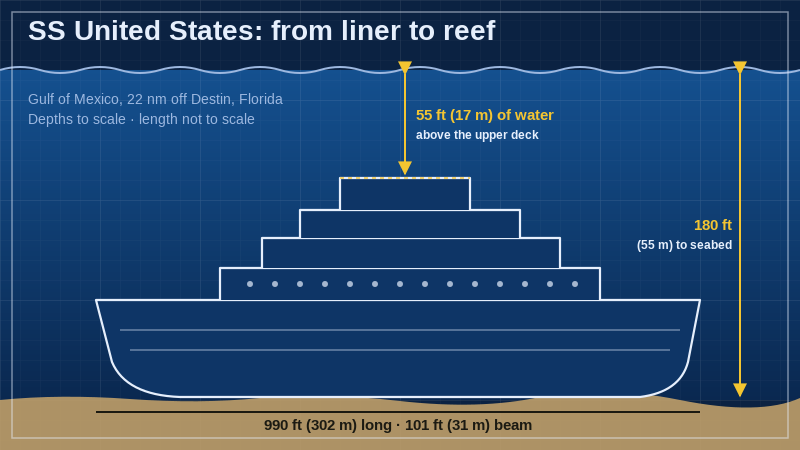
The ship was the life's work of naval architect William Francis Gibbs. She was built by Newport News Shipbuilding in Virginia, where her keel was laid on 8 February 1950. She is 990 feet (302 m) long, and her beam of 101 feet was chosen so she could pass through the Panama Canal locks with about two feet to spare on each side.
Gibbs feared fire more than anything at sea, so he banned wood. Cabins, furniture and fittings were made of metal and other non-burning materials. The famous exception was the grand pianos, made of a fire-resistant mahogany.
To keep her light and stable, the whole superstructure was built of aluminium. The conservancy that later cared for the ship says more aluminium went into her than into any construction project before. Less weight high up lowers the centre of gravity, which let the hull be slimmer and faster.
A liner that was also a troopship
The US government helped pay for her because she could be converted to a troop transport in wartime, able to carry 14,000 troops 10,000 miles without refuelling. Her real top speed was kept secret for years. On trials she reached 38.32 knots, about 71 km/h.
The record that still stands
On her maiden voyage in July 1952 she broke the transatlantic speed record in both directions, averaging more than 35 knots eastbound. That won her the Blue Riband, and no passenger liner has beaten it since.
Jet airliners soon took her passengers. She was retired in November 1969, and from 1996 she sat at a pier in Philadelphia while supporters tried to save her.
How you sink a ship on purpose
In 2026 she was towed from Mobile, Alabama, to a site about 22 nautical miles off Destin-Fort Walton Beach in Okaloosa County, Florida. Federal rules did not allow explosives, so she was sunk by controlled flooding.
- Fuel, wiring and other harmful materials were removed first.
- Openings were cut through her decks and more than 400 portholes were taken out, so water could flow in evenly and divers could later swim through safely.
- Compartments too dangerous for divers were sealed.
- Valves were opened together so she would flood level and settle upright.
She is planned to rest in about 180 feet (55 m) of water, with roughly 55 feet (17 m) of water above her upper deck, within reach of recreational divers. Scientists from Woods Hole Oceanographic Institution, Dauphin Island Sea Lab and Louisiana State University will monitor how sea life settles on the wreck.
Why a reef?
A large steel structure on a flat, sandy seabed gives coral, sponges and fish something to attach to and shelter in. Within a few years an artificial reef like this usually becomes a busy habitat, and a dive site that brings visitors to the coast.
Design for the whole life of a structure. Gibbs planned for speed, fire safety and wartime use. Seventy-four years later, careful planning turned the end of her life into something useful too.
Diagram by EngCalcu. Depths from Okaloosa County's published sinking plan as reported by Baird Maritime; ship facts from the SS United States Conservancy and Ships Monthly.
Enjoyed this story? A thumbs-up tells us to write more like it.